2026 Election: Head & Neck Cancer Community Questions
We asked. They answered.
People affected by head and neck cancer told us what matters to them. We put their questions to political parties and invited them to respond.
The Head and Neck Cancer Support Network Trust does not endorse or recommend any political party. We are publishing the responses as provided so our community can compare the individual positions of the parties and make their own informed decisions.
Why we asked
Head and neck cancer can have a profound and lasting impact on people and their whānau. The effects of treatment can extend well beyond the end of cancer treatment and may affect eating, swallowing, speech, dental health, appearance, hearing, mental well-being, employment and quality of life.
With the 2026 General Election approaching, we wanted to know what political parties would do to address the issues that matter to our community.
So we asked our community what questions they wanted political parties to answer.
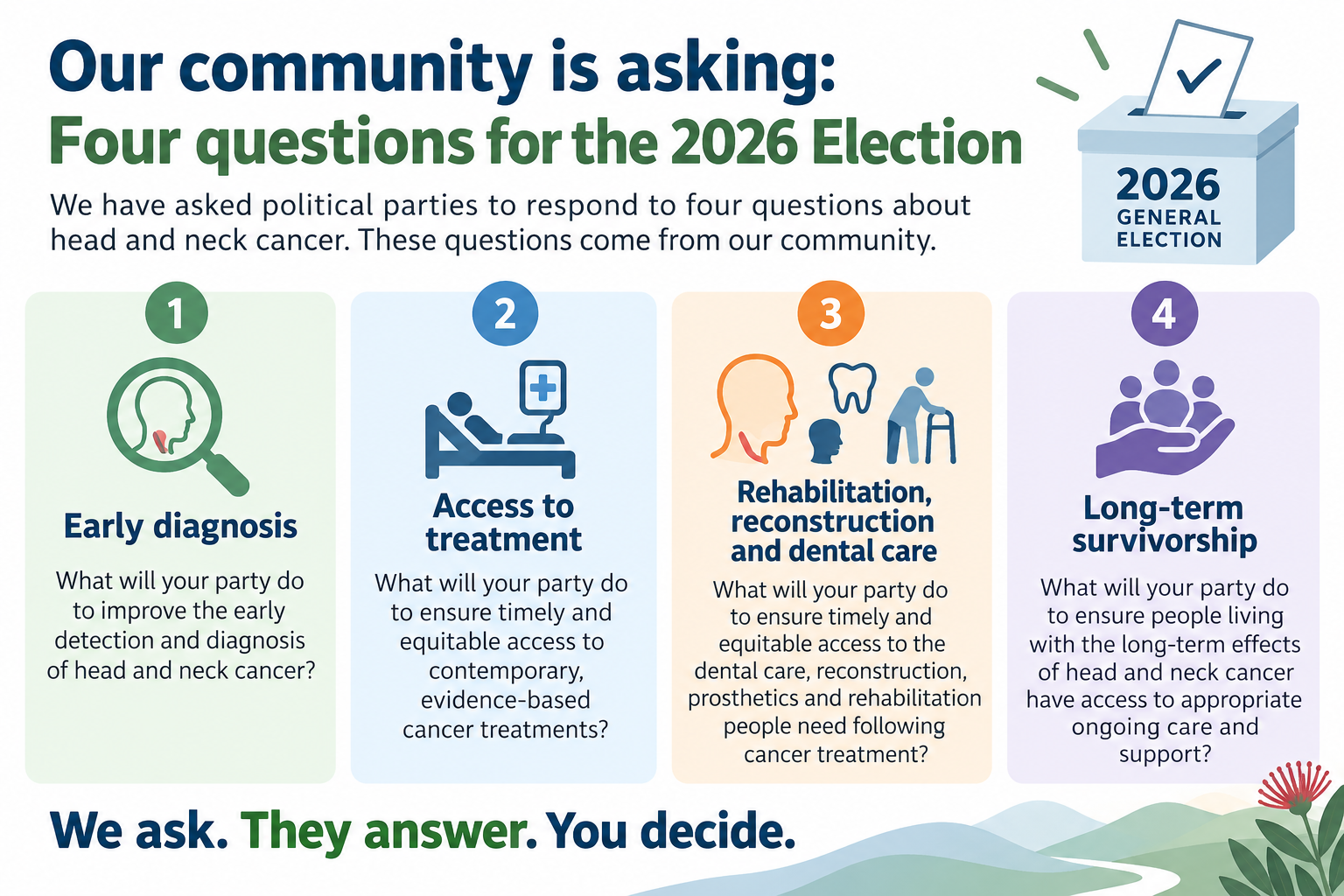
Here are the questions we sent to each political party. We limited answers to 150 words. To find out why we did this, click here. LINK
1. Early diagnosis
What will your party do to improve the early detection and diagnosis of head and neck cancer, recognising that earlier diagnosis can improve treatment options, outcomes and people's ability to return to work and everyday life?
ACT New Zealand
Reponsee
New Zealand First
Reponsee
New Zealand Labour Party
Reponsee
Opportunity Party
Many head and neck cancers are first noticed by a GP, dentist or pharmacist, so earlier diagnosis depends on people getting in the door. A quarter of adults (25.5 per cent) say appointment waits have stopped them seeing a GP. The Opportunity Party will seek a cross-party ten-year Health Plan that lifts primary and community care from 5.7 to 10 per cent of Health New Zealand's spending, starting with workforce: retaining clinicians, expanding training places and building the wider practice team. We support a staged expansion of publicly funded basic dental care, starting with those facing the greatest barriers, because many oral cancers are first seen in the dental chair. Hospital and specialist services are funded on the same ten-year path, so diagnostic capacity grows alongside detection. On prevention, we support a credible path back to smokefree and reducing alcohol harm, two major risk factors.
Te Pāti Māori
Reponsee
The Green Party of Aotearoa New Zealand
Reponsee
The New Zealand National Party
Reponsee
2. Access to contemporary treatment
What will your party do to ensure that people affected by head and neck cancer in Aotearoa have timely and equitable access to contemporary, evidence-based cancer treatments?
ACT New Zealand
Reponsee
New Zealand First
Reponsee
New Zealand Labour Party
Reponsee
Opportunity Party
Contemporary treatment depends on specialists, equipment and medicines that take years to put in place, and New Zealand funds them three years at a time. The New Zealand Cancer Action Plan was rewritten in July 2026 with a three-year horizon. The Opportunity Party will seek a legislated, cross-party ten-year Health Plan that gives cancer services a funding horizon matching the time it takes to build them. Health funding would rise to around 9 per cent of GDP over ten years, with cost pressures met in full every year before any new announcement, and no cuts in a downturn. We support a stable, growing medicines budget with independent clinical prioritisation by Pharmac. The Plan includes published workforce projections so training providers and colleges can size specialist intakes a decade ahead. Rural access is a specific outcome measure in the Plan, with progress reported annually to Parliament rather than to the Minister.
Te Pāti Māori
Reponsee
The Green Party of Aotearoa New Zealand
Reponsee
The New Zealand National Party
Reponsee
3. Rehabilitation, reconstruction and dental care
What will your party do to ensure that people affected by head and neck cancer have timely and equitable access to the dental care, reconstruction, prosthetics and rehabilitation they need following cancer treatment, regardless of where they live or their financial circumstances?
ACT New Zealand
Reponsee
New Zealand First
Reponsee
New Zealand Labour Party
Reponsee
Opportunity Party
Public dental support largely ends at 18, leaving cost as a barrier for many people after cancer treatment. The Opportunity Party supports a staged expansion of publicly funded basic dental care, starting with those facing the greatest barriers and sequenced to workforce capacity so that eligibility turns into actual treatment. We will not put a date or figure on it; a fully universal scheme is not affordable within our funding path, and we will not pretend otherwise. Reconstruction, prosthetics and rehabilitation depend on specialist and allied health workforce that is currently planned year to year. Our ten-year Health Plan funds workforce projections across the system and treats rural access as a measured outcome, including telehealth that reduces unnecessary travel. How funding is split between services is a decision for the clinicians running the system, answerable publicly for results.
Te Pāti Māori
Reponsee
The Green Party of Aotearoa New Zealand
Reponsee
The New Zealand National Party
Reponsee
4. Long-term survivorship
What will your party do to ensure that people living with the long-term effects of head and neck cancer and its treatment have access to appropriate ongoing care and support?
ACT New Zealand
Reponsee
New Zealand First
Reponsee
New Zealand Labour Party
Reponsee
Opportunity Party
Long after treatment ends, most ongoing care happens in the community: GPs, nurses, pharmacists, allied health and mental health support. That is the part of the system The Opportunity Party would grow fastest, taking primary and community care from 5.7 to 10 per cent of Health New Zealand's spending over ten years. The areas with the strongest evidence for that investment include long-term condition management and mental health in primary care. The first money buys people, building out the wider practice team around the GP so care is coordinated rather than left to patients and whānau to arrange. We also support connecting and completing digital health so one record follows people between their practice, hospital and specialists, and they stop repeating their history. Care that lasts for years needs funding that does too; a ten-year Health Plan, reported annually to Parliament, provides it.
Te Pāti Māori
Reponsee
The Green Party of Aotearoa New Zealand
Reponsee
The New Zealand National Party
Reponsee
What happens next?
This project is one part of our ongoing advocacy for people affected by head and neck cancer.
We will continue to bring the experiences and priorities of our community to decision-makers, whoever forms the next Government.
The election is an opportunity to ask questions. The work continues afterwards.
About this project
How we did this
We asked people affected by head and neck cancer what they wanted political parties to address.
We used those responses to develop the questions.
Every political party received the same questions.
Every party was given the same deadline.
Responses are published substantially as received.
The Trust has not edited responses to change their meaning.
The Trust has not scored, ranked or endorsed the responses.
A party's failure to respond is recorded.
Why did we ask for a maximum of 150 words?We asked political parties to keep their responses to a maximum of 150 words for each question.
This was not intended to restrict what parties could say. It was designed to make the process fair, accessible and useful to our community.
Every party has been given the same questions, the same word limit and the same opportunity to respond. Keeping responses concise makes it easier for people to compare the parties' answers and understand what each party is proposing.
It also encourages parties to focus on what matters most: what they would actually do for people affected by head and neck cancer.
We recognise that complex health issues cannot always be fully explained in 150 words. The purpose of this exercise is therefore not to provide a comprehensive account of each party's health policies, but to give our community a clear opportunity to hear each party's response to the questions that matter to them.
Where a party provides additional information or links alongside its response, we may include these so that readers can explore the issue further.